
Family-owned · Denver Local
Tree Removal and Vegetation Management for Defensible Space
Call directly(303) 304-9997Instant Quote
Your estimate starts here.
We'll follow up within one business day. No pressure, no upsells.
Overview
Why Choose Complete Estate Care for Tree Removal and Vegetation Management for Defensible Space
Tree removal on a Colorado wildfire-exposed property is not a tree-service job. It's fuel management. Most crews that show up to "take down a few trees" have no idea which trees actually matter for defensible space, how far apart the crowns need to sit, or how high the ladder fuels have to be pruned to stop a surface fire from climbing into the canopy. Joe Slota at Complete Estate Care walks your lot against Colorado State Forest Service (CSFS) zone standards first, then removes and thins only what interrupts the fire's path to your structure. Complete Estate Care is a Division of Complete Estate Care LTD, a licensed general contractor, and the work is documented so it holds up for both your insurer and Colorado's mitigation tax credit. Call Joe at (303) 304-9997 for a free on-site assessment before the crowns close in.
The scope and cost of vegetation management depend on stand density, the species mix on your lot, slope, and how many trees are already dead or dying. A quarter-acre with scattered ponderosa reads very differently from a forested acre near Evergreen or Golden where lodgepole grew in tight after decades of fire suppression. Clearing the vegetation is step one before hardening the structure itself. Every property is different. Contact Complete Estate Care for an accurate estimate.
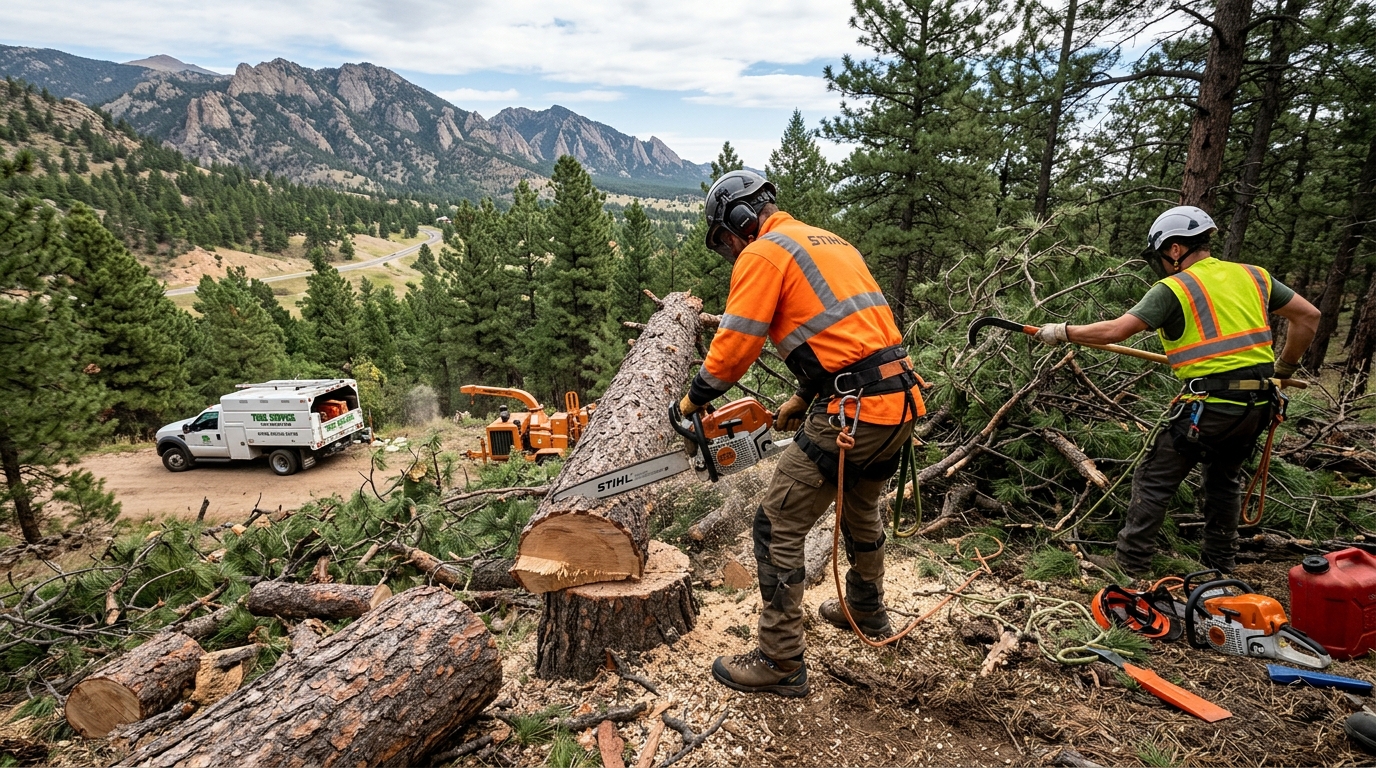
Thinned ponderosa pine stand with spaced crowns after defensible-space tree removal in the Colorado foothills
Why Tree Removal Is Really Fuel-Continuity Management
Here's the frame nobody selling "tree removal services" will give you: on a wildfire lot, you are not removing trees for looks or clearance. You're breaking fuel continuity. Fire moves two ways across a property. It runs horizontally along continuous vegetation, and it climbs vertically from grass and shrubs into low branches and up into the canopy. Once it's in the crowns and jumping tree to tree, flame lengths hit 100 to 200 feet and nothing on the ground stops it. So the whole job comes down to two questions on every tree: does this crown sit close enough to the next one to carry a crown fire, and does anything grow low enough on this trunk to ladder a surface fire up into it. Answer those correctly across Zones 1 and 2 and you've done the single highest-value thing a saw can do on a Colorado property. That's the work. Not counting trees.
Tree Removal Services Built Around CSFS Zone Standards
The order of operations matters. We assess, mark crown spacing and ladder-fuel targets against the CSFS three-zone model, then remove and prune to that plan. Here's what each part actually involves on a Front Range lot:
Crown spacing: how far apart trees have to sit
CSFS guidance calls for at least 10 feet between individual tree crowns in Zone 1 (roughly 5 to 30 feet from the structure) and wider spacing on slopes. On the ground that usually means dropping the smaller or lower-value trees in a tight cluster and keeping the healthiest, then re-checking spacing from the edges of the crowns, not the trunks. We mark crown spacing before a single tree comes down so you can see the finished layout first.Ladder-fuel pruning: cutting the bridge to the canopy
Ladder fuels are the low branches, shrubs, and young saplings that bridge a ground fire up into a mature crown. The fix is pruning every retained tree's lower branches to 6 to 10 feet off the ground (never more than a third of the live crown in one season) and clearing the brush directly under it. This one step is what most DIY clearing misses entirely.Zone 2 thinning: breaking the run before it starts
Zone 2 (30 to 100-plus feet) doesn't get cleared to bare dirt. It gets thinned into groups with space between the clumps, so a fire loses momentum before it reaches Zone 1. On slopes we push Zone 2 further downhill, because for every 10 degrees of grade the spread rate roughly doubles and fire arrives hotter and faster from below.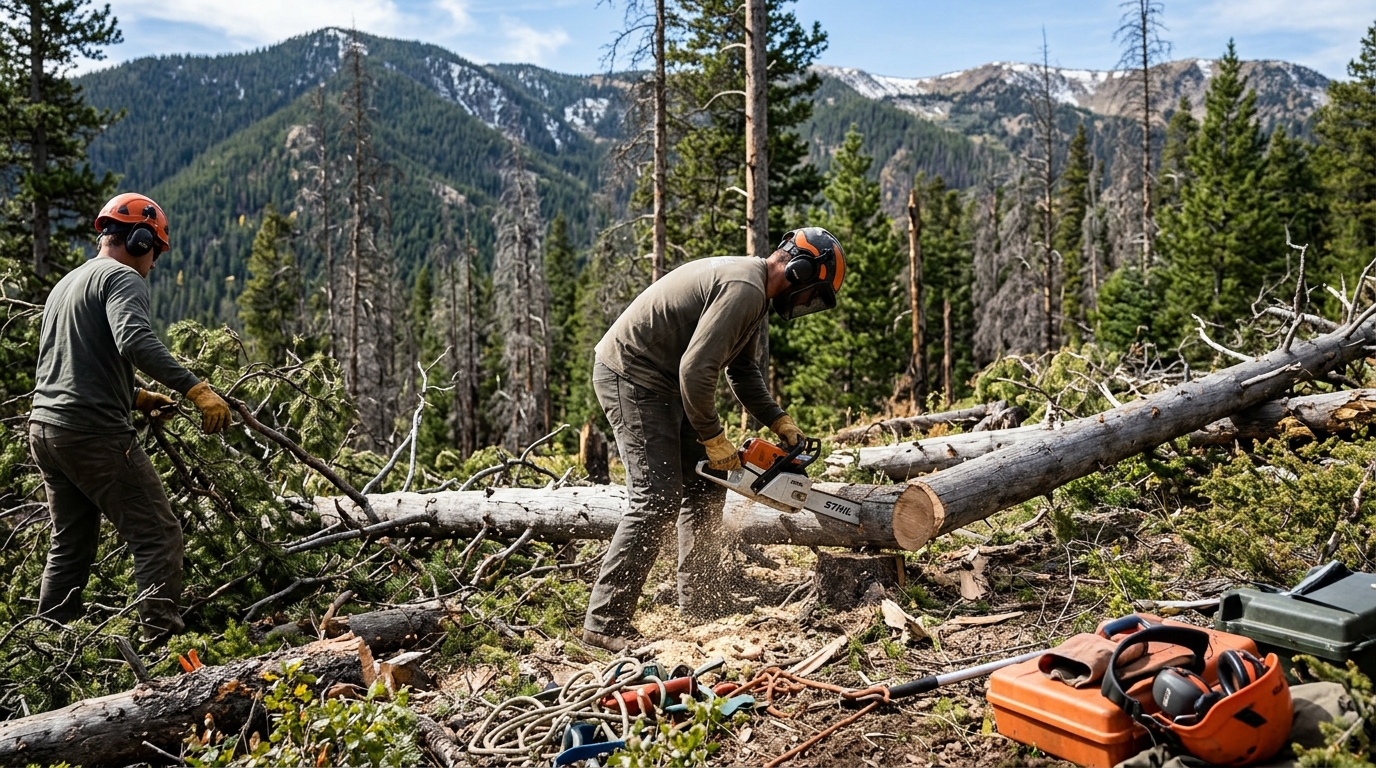
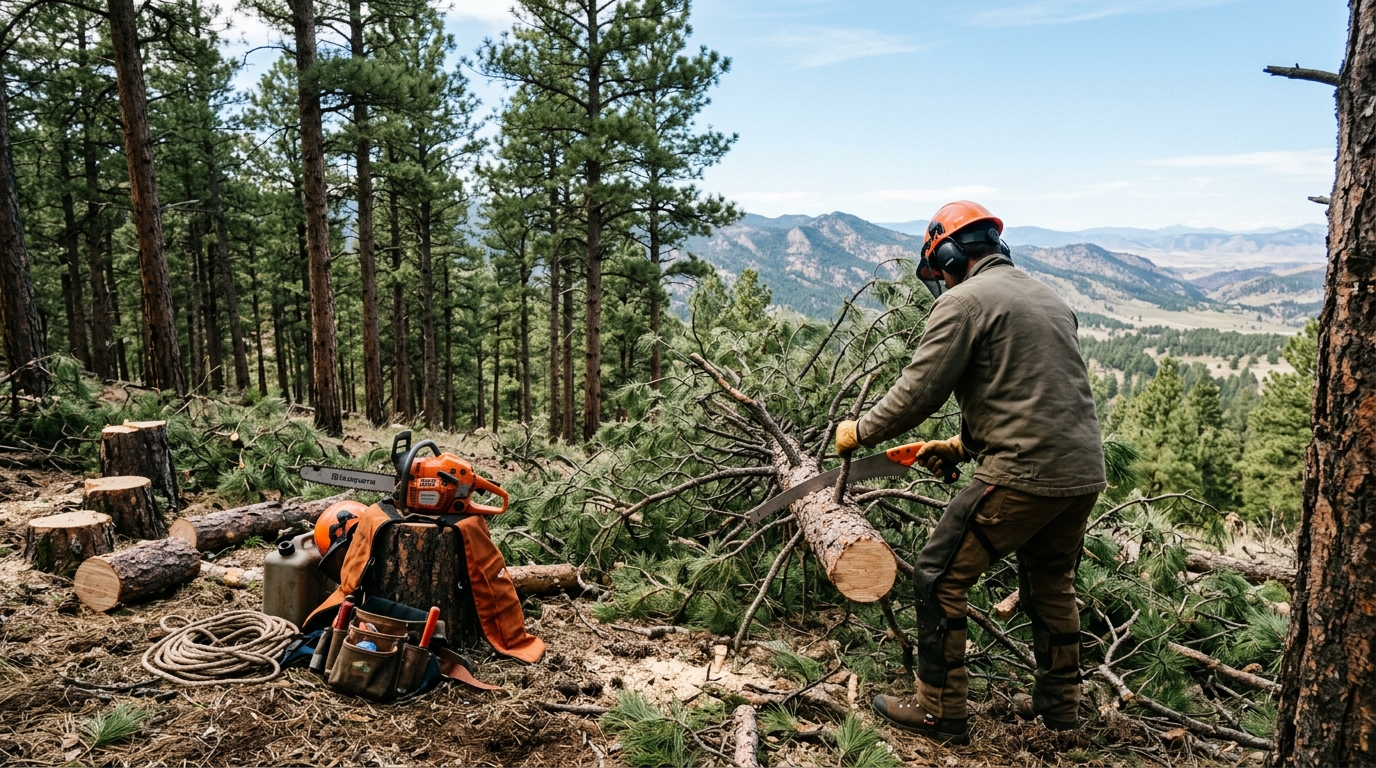
Standing dead beetle-killed pine flagged for removal on a Colorado mountain property
Slash Removal and Dead Tree Removal: Finishing the Job
This is the part almost every generic tree-service page skips, and it's where jobs go wrong. Cutting the tree down is half the work. The cut branches, tops, and small-diameter material left behind are called slash, and a pile of fresh slash is drier and more flammable than the standing tree was. Leaving it on the ground undoes the mitigation you just paid for.
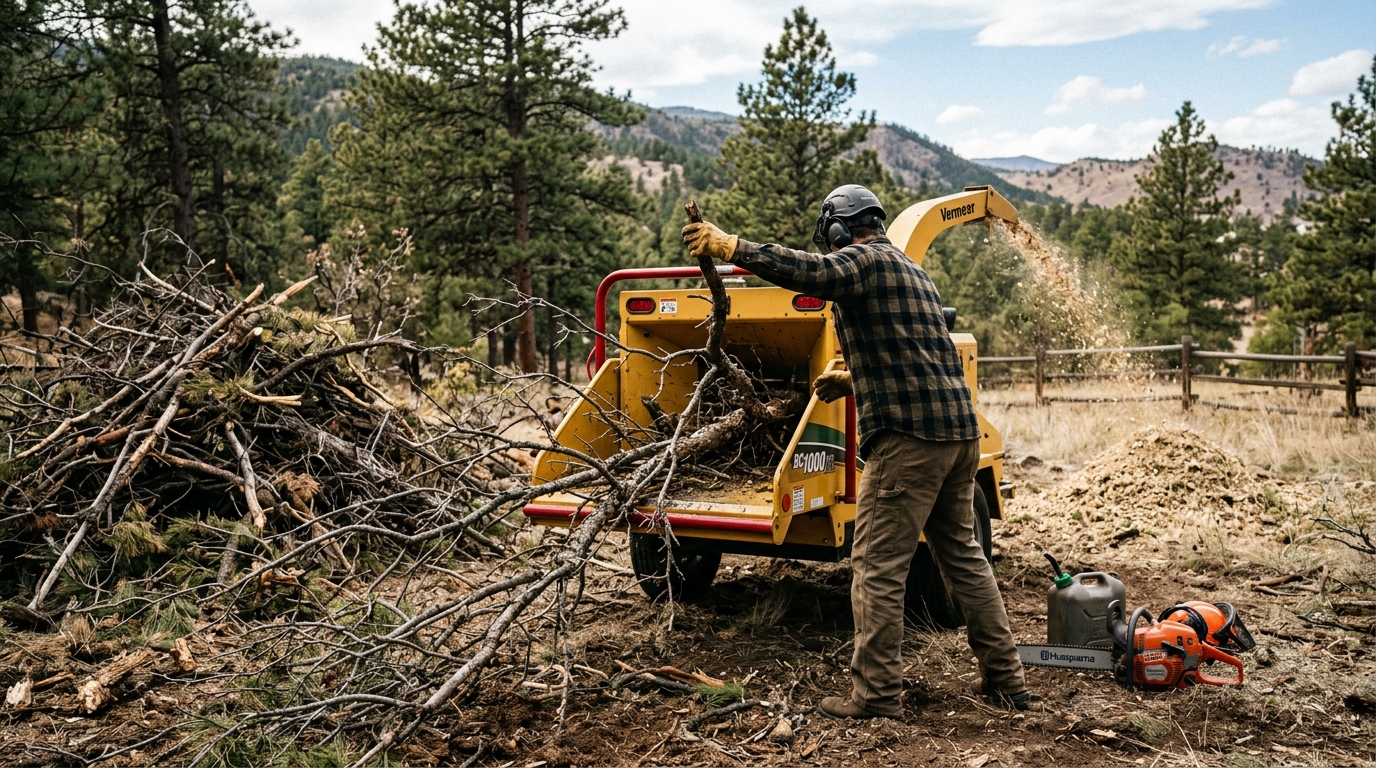
Slash removal has to be part of the scope, not an afterthought. Depending on access and county rules, that means chipping on site, hauling to a slash-collection site, or lop-and-scatter where material is cut short and spread thin so it composts fast instead of curing into fuel. We sequence the disposal method into the quote so there's no surprise pile sitting in Zone 1 a week after the crew leaves.
"If a bid doesn't say in writing how the slash leaves the property, it isn't a defensible-space bid. It's a tree-cutting bid, and you'll be looking at the pile in July."
Dead tree removal gets priority sequencing by proximity to structures. Beetle-killed and standing dead trees next to the house come down first, because they ignite fast and burn hot. Get a free quote and we'll flag the priority order before anything comes down.
Fire Resistant Plants for Landscaping After Clearing
Once trees and shrubs come out, what you replant matters as much as what you removed. Fire resistant plants for landscaping in Zone 1 share three traits: high moisture content, low resin, and a habit that stays short and clean. On the Front Range, the shortlist is consistent:
Native grasses over ornamentals
Blue grama, buffalo grass, and other low native grasses stay short, hold moisture, and don't build the fuel load that ornamental exotics do. They're the safe replacement once a tree or shrub comes out near the structure.High-moisture deciduous plants
Deciduous species like aspen, chokecherry, and serviceberry carry higher moisture content and resist ignition far better than resinous conifers. Where you want to keep greenery in Zone 1, these earn their place.Remove juniper near structures
Juniper is the one to pull. It's one of the most-planted Front Range species and one of the worst near a home. Its volatile oils can throw a fireball that ignites siding from 15 feet. If it's within 30 feet of the structure, it comes out. Cut slash and branch debris staged for removal beside a cleared Front Range property
When You Don't Need This (and When You Do)
When this service is the wrong call: if your last professional defensible-space assessment was inside the past two years, your crowns are already spaced, and no new trees have died or grown into the gaps, you probably don't need us out there yet. Book a free CSFS inspection through your county or fire district first and confirm. We would rather tell you to wait than sell you a clearing job your property doesn't need. What does trigger real urgency: new beetle-kill, standing dead timber within a hundred feet of the house, closed-in crowns after a wet few years, or an insurer asking for documented mitigation. Those don't get better on their own.
The Money Side: Tax Credit and Insurance Documentation
Done right and documented, this work pays you back in two directions most tree services never mention:
Colorado mitigation tax credit (CRS 39-22-543)
Colorado offers a state income tax credit of up to $2,500 per year on out-of-pocket wildfire mitigation costs paid to a licensed contractor, under CRS 39-22-543. Tree removal and vegetation thinning for defensible space qualify. Because Complete Estate Care is a Division of a licensed general contractor, the work and paperwork line up with what the credit requires.Insurance documentation under HB25-1182
Several carriers writing policies in Colorado wildland-urban interface zones now ask for documented defensible-space compliance as a condition of coverage or a factor in your premium. HB25-1182 formalized that documentation pathway. You get a written record of the thinning and removal you can hand straight to your insurer. Key Facts: What Drives Defensible-Space Tree Work
The standards below come from CSFS, NFPA, and Colorado statute. Each one drives a specific decision on your property.
Ladder-fuel pruning to 6-10 feet
Slope doubles spread every 10 degrees
Dead trees stay flammable for years
Slash disposal is part of the job
Up to $2,500 back per year in Colorado
Protection Cost Estimate
Get Your Free Vegetation Management Assessment
Joe assesses every property personally, marks crown spacing and ladder-fuel targets before anything comes down, and sequences dead tree removal and slash disposal into one clean scope. No call center, no subcontractors, no surprise pile left in Zone 1. Call (303) 304-9997 or request a free quote to get on the schedule.
Call (303) 304-9997 Free · No obligation
Or send us your info
FAQ Common questions
Frequently Asked Questions
Answers below
How far should trees be from a house for fire safety? +
For fire safety, thin trees so crowns sit at least 10 feet apart within 30 feet of the house (Zone 1), keep the immediate 5 feet around the structure free of trees and shrubs entirely (Zone 0), and thin trees into spaced groups from 30 to 100-plus feet out (Zone 2). Distances extend further on slopes because fire spreads faster uphill. It's less about one magic number from the house and more about crown-to-crown spacing and removing any tree whose branches can ladder a ground fire into the canopy. A CSFS-aligned assessment maps the exact spacing for your lot.
What is slash removal and why does it matter for wildfire mitigation? +
Slash is the cut branches, treetops, and small-diameter material left over after trees are removed or pruned. It matters because fresh slash dries out fast and becomes more flammable than the living tree was, so leaving it on the ground undoes the mitigation. Depending on access and county rules, slash removal means chipping on site, hauling to a slash-collection site, or lop-and-scatter where material is cut short and spread thin to compost. Complete Estate Care builds the disposal method into the quote so no fuel pile is left behind in your defensible space.
Should I remove dead and beetle-killed trees before fire season? +
Yes, and it should be a priority. Beetle-killed pines and other standing dead trees retain dry, volatile resin for two to three years after death and ignite far faster and hotter than living trees. Dead timber within about 100 feet of a structure is a direct fire-loading problem. Complete Estate Care sequences dead tree removal by proximity to buildings, so the trees closest to your home come down first. If you're seeing rust-colored needles, bare gray crowns, or bark falling away, get those flagged before fire season.
What are the best fire resistant plants for landscaping in Zone 1? +
In Zone 1, the best fire resistant plants for landscaping share three traits: high moisture content, low resin, and a low, clean growth habit. On the Front Range that means native grasses like blue grama and buffalo grass, high-moisture deciduous species like aspen, chokecherry, and serviceberry, and low native perennials. Gravel and stone are the right non-combustible ground cover in the first 5 feet. Avoid juniper and other resinous conifers within 30 feet of the structure. Juniper is one of the most-planted and most dangerous species near Colorado homes.
Do I actually need tree removal, or can it wait? +
Not always. If you had a professional defensible-space assessment within the past two years, your crowns are already spaced, and no new trees have died or filled in the gaps, you likely don't need clearing yet. Book a free CSFS or fire-district inspection first to confirm. The work becomes worth it when you have new beetle-kill, standing dead timber near the house, crowns that have closed in after wet years, or an insurer asking for documented mitigation. Complete Estate Care will tell you to wait if that's the honest answer for your property.
Does tree removal for defensible space qualify for the Colorado tax credit? +
Yes. Colorado offers a state income tax credit of up to $2,500 per year on out-of-pocket wildfire mitigation costs paid to a licensed contractor under CRS 39-22-543, and defensible-space tree removal and thinning qualify. Because Complete Estate Care is a Division of Complete Estate Care LTD, a licensed general contractor, the work and documentation align with what the credit requires. You also get a written record suitable for insurance carrier review under HB25-1182. Call (303) 304-9997 to discuss documentation for your situation.