
Family-owned · Denver Local
Roof Repair and Hail Damage Repair Built for Colorado Storms
Call directly(303) 304-9997Instant Quote
Your estimate starts here.
We'll follow up within one business day. No pressure, no upsells.
Overview
Why Choose Complete Estate Care for Roof Repair and Hail Damage Repair Built for Colorado Storms
Hail damage roof repair in Colorado is a storm-damage problem before it's a carpentry problem, and that's the part most roofers get backwards. Your roof didn't just wear out. Somewhere along the Front Range hail belt it took a beating from hail, wind, an ice dam, or ember fallout, and now water is finding its way in. Joe Slota at Complete Estate Care assesses the actual cause of the leak first, repairs it to hold against the next storm cycle, and documents the damage the way an insurance adjuster needs to see it, because on most Colorado roofs the repair and the claim are the same conversation. Complete Estate Care is a Division of Complete Estate Care LTD, a licensed general contractor, so the work and the paperwork line up. Call Joe at (303) 304-9997 for a free on-site roof assessment.
What drives the scope and cost of a roof repair is the cause and extent of the damage, not the square footage alone. A dozen wind-lifted shingles on a five-year-old roof is a very different job from hail bruising across an entire south-facing slope, or an ice-dam leak that has already soaked the decking near Evergreen or up in Grand County. Age of the roof, pitch, decking condition, flashing failures, and whether the damage is a covered loss all change the picture. Repairing the roof is also step one before hardening the structure against wildfire, because a Class-A roof is the single highest-impact upgrade on a Colorado home. Every roof is different. Contact Complete Estate Care for an accurate estimate.
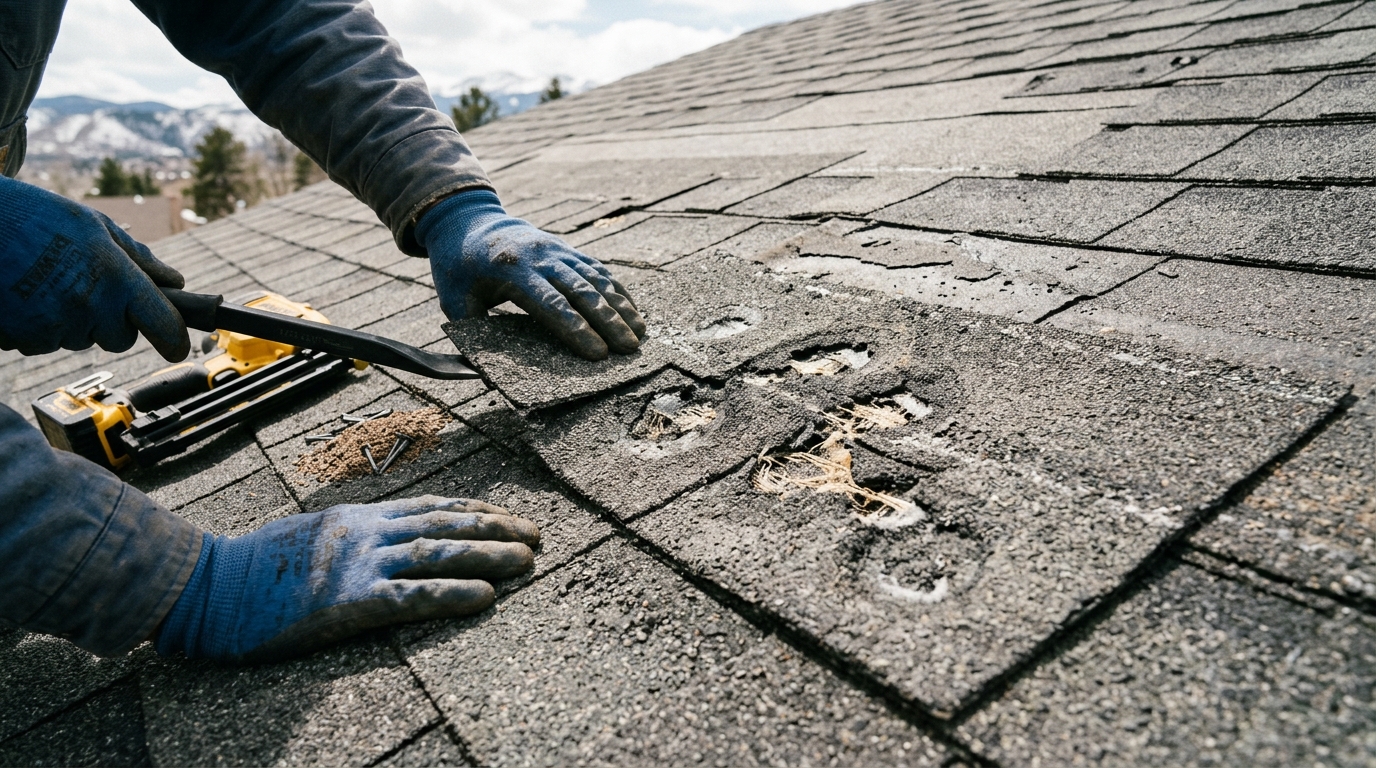
Close-up of hail-impact bruising and granule loss on asphalt roof shingles from a Colorado hailstorm
Roof Repair: Diagnose the Cause Before You Fix the Leak
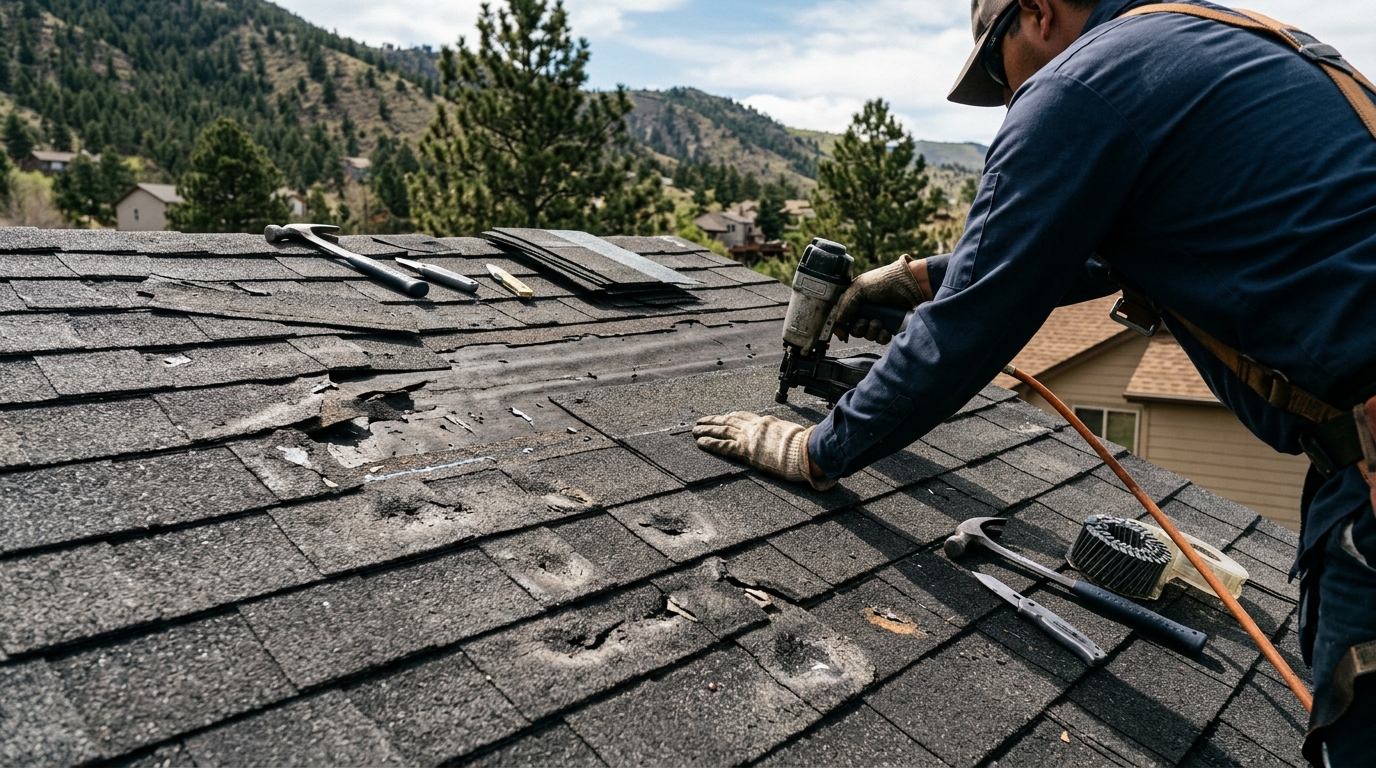
A roof repair starts with finding why the water is getting in, and on the Front Range the answer is almost always storm damage, not old age. A straightforward repair (a cluster of wind-lifted shingles, a failed pipe boot, a length of loose flashing) runs a few hours once we're on the roof, weather permitting. But the diagnosis comes first. Joe walks the roof, checks the attic side for staining and wet decking, and traces the leak back to its actual entry point instead of smearing sealant on the wet spot. Here's the frame nobody selling "roof repair services" will hand you: on a Colorado roof, the leak you can see is a symptom, and the hail or wind damage that caused it is usually spread across a whole slope. Fix the one shingle and ignore the field damage around it, and you're back up there after the next storm. We repair the leak and flag the surrounding damage so you know whether you're looking at a spot fix or a claim.
Roof Damage From Hail, Wind, and Ice: The Four Colorado Causes
Most roof leaks on Colorado homes trace back to one of four storm causes, and each one gets repaired differently. Naming the cause correctly is what makes a repair hold and what makes a claim stick. Here's what we're actually looking for on the roof:
Hail damage: the bruising you can't see from the driveway
The Front Range sits inside what insurers call Hail Alley, the corridor from the mountains east across the plains that takes more damaging hail than almost anywhere in the country. Hail doesn't always punch a hole. More often it bruises the shingle, knocking off the protective granules and leaving soft spots that shed water and fail early. Those bruises are exactly what an adjuster looks for, and they're easy to miss from the ground. We chalk and photograph every impact per slope.Wind damage: lifted shingles that unzip a slope
Front Range downslope and chinook winds routinely gust past 60 to 80 mph, and they peel shingles from the edges and ridges first. A wind-lifted shingle breaks its seal, flaps, and lets wind-driven rain and snow underneath. Left alone, one lifted course unzips a whole row. Wind-damaged roof repair means re-securing or replacing the lifted shingles and checking the seal integrity across the exposed edges, not just tacking down the one that's obviously flapping.Ice-dam leaks: water running uphill under the shingles
At elevation and on shaded north slopes, snow melts over the warm center of the roof and refreezes at the cold eave, building an ice dam. Water pools behind the dam and backs up under the shingles, past where they're designed to shed it, and into the decking and the ceiling below. This is the classic mountain-home winter leak. The repair addresses the leak point and the flashing, but the real fix is often ventilation and eave protection so the dam stops forming.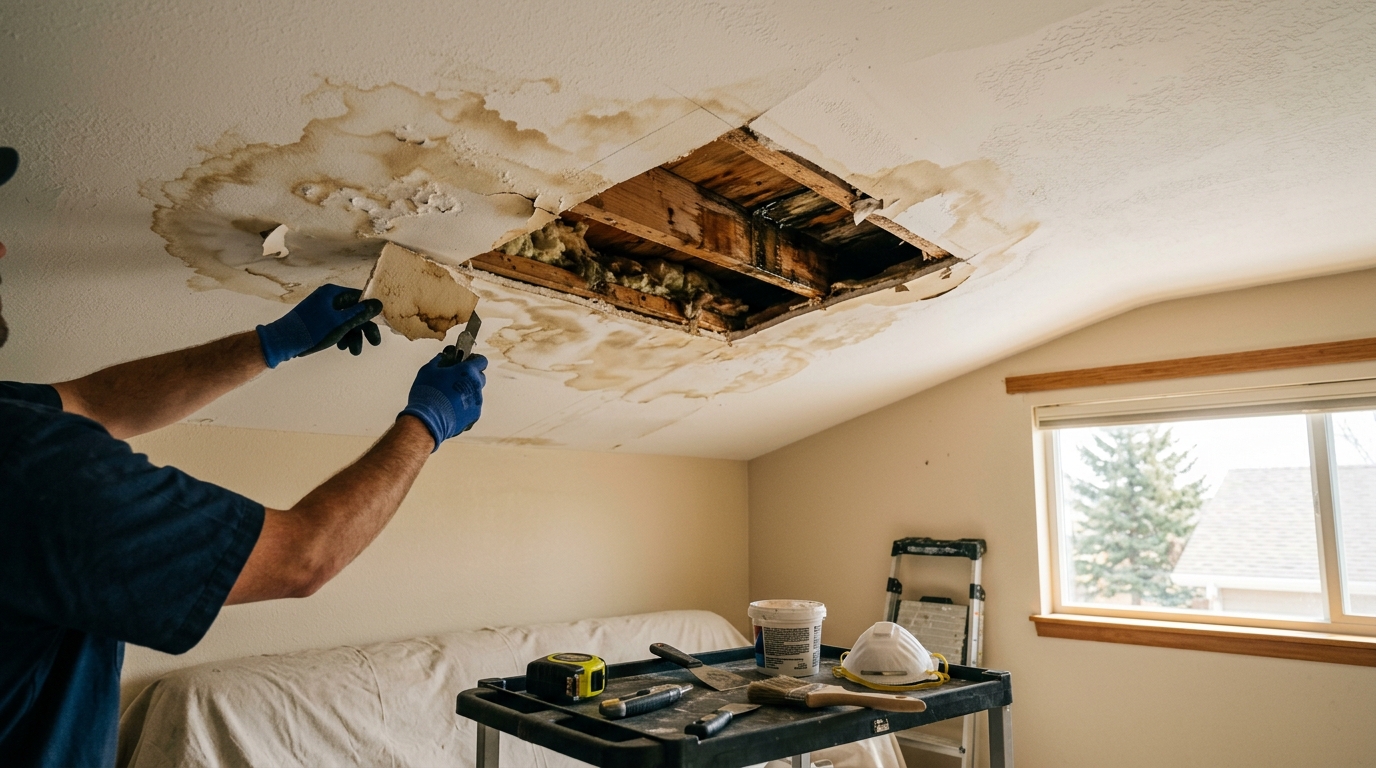
Water stain and leak damage spreading across an interior ceiling below a failed roof on a Colorado home
Hail Damage Roof Repair: Granule Loss, Bruising, and the Repair-vs-Replace Line
Hail damage roof repair on the Front Range starts with reading the damage you can't see from the driveway, because the damage that costs you the roof almost never looks dramatic from the yard. After a cell moves through Golden, Evergreen, or the foothills, the two calls we get are homeowners with a visible leak and homeowners whose roof "looks fine" who just got told by a door-knocker that it's totaled. Both are usually wrong about what's actually on the roof. Joe walks it slope by slope, chalks and photographs every impact, and makes the repair-or-replace call on evidence instead of a ground-level guess.
What hail actually does to a shingle
Roof damage from hail is mostly granule loss and bruising, not holes. The hailstone knocks the protective granules off the asphalt shingle and fractures the mat underneath, leaving a soft, darkened bruise that gives under a thumb. The granule loss is the tell. Once the mat is exposed, Colorado UV and freeze-thaw finish the shingle over the following seasons, which is why a roof can lose a claim on a clear day months after the storm. The bruise doesn't heal. It waits for the next freeze-thaw cycle to open up. Here's what the common materials show after a Front Range hail event:
- Asphalt shingles: round bruises where granules are stripped to the black mat, soft spots that give under a thumb, and cracked or lifted tabs. The granule loss is what an adjuster looks for. - Metal and standing-seam: dents and dimpling, usually cosmetic unless a seam or the finish is breached. Metal sheds hail far better than asphalt. - Class 4 impact-rated shingles: carry the top UL 2218 impact rating and resist cracking from hail that would bruise a standard three-tab, worth the conversation on any home that's been hit more than once. - Soft metal flashing, vents, and gutters: dents here are often the first visible proof a storm was severe enough to have bruised the field of the roof.
"A storm that looks minor from the yard routinely bruises an entire south or west-facing slope, and those are the faces that take the wind-driven hail here. Document it slope by slope while it's fresh, or the claim fades with the bruise."
Hail damage repair vs. roof replacement
Repair when the hail damage is isolated and the roof otherwise has life left. Replace when the bruising is spread across whole slopes or the roof was already near the end. The line is about how much of the field is compromised, not how many shingles are visibly gone. A handful of cracked tabs and a split pipe boot on an eight-year-old roof is a repair. Granule loss and soft bruising across the south and west faces of a fifteen-year-old roof is a replacement, because every bruised shingle is a future leak. If you're replacing in Hail Alley anyway, Class 4 impact-rated shingles or standing-seam metal resist the next storm instead of resetting the clock on the same vulnerability.
For the full breakdown of asphalt versus metal, the insurance-claim window, and how to spot a hail-season leak, read our deeper guide on roof hail damage in Colorado and when to repair vs. replace. If a hail cell just worked your part of the Front Range, call (303) 304-9997 and we'll read the roof honestly before anyone talks about a tear-off.
Close-up of hail-impact bruising and granule loss on asphalt roof shingles from a Colorado hailstorm
Roof Leak Fix: How We Trace a Leak Back to Its Source
Roof leak fix work is where the real diagnosis happens, because water almost never enters where it drips inside. It travels along the decking, down a rafter, and shows up on the ceiling several feet from the actual breach.
So how do you fix a roof leak correctly? You start at the interior stain, go up into the attic to find where the decking is wet and follow the water back uphill to the entry point, then confirm from the roof surface. The usual suspects are failed pipe boots (the rubber gasket around plumbing vents cracks in Colorado's UV and freeze-thaw within 8 to 12 years), lifted or missing shingles, rusted or separated flashing at walls and chimneys, and ice-dam backup at the eaves. Each one gets a different repair. A cracked boot gets replaced. Flashing gets re-set and sealed. Ice-dam damage gets the leak fixed plus a ventilation and eave-protection recommendation so it doesn't come back.
"If a roofer quotes a leak fix without going in the attic first, they're guessing where the water comes in. On a Colorado roof, guessing means you're both back up there after the next storm."
If you've got an active leak and water is sitting in the ceiling, don't wait for it to spread. Call (303) 304-9997 and we'll trace it back to the source.
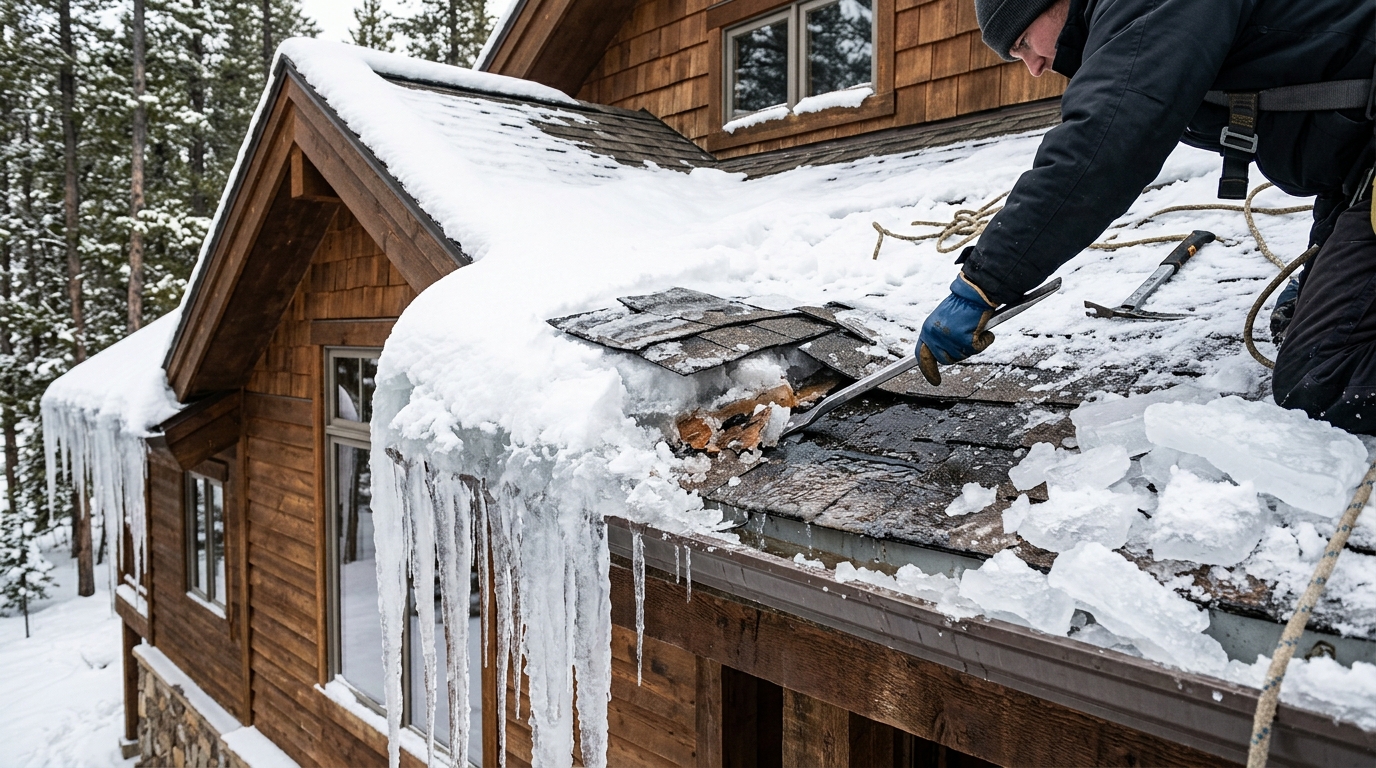
Ice dam and icicles along the eave of a Colorado mountain-home roof, water backing up under the shingles
When a Repair Is the Wrong Call (and When It's Exactly Right)
When roof repair is the wrong call: if your roof is 20-plus years old, the shingles are curling and brittle across every slope, and you're patching a new leak every season, a repair is money spent to delay the inevitable. At that point a full replacement is the honest recommendation, and if the damage traces to a documented storm, replacement may be a covered loss anyway. We'll tell you when you've crossed that line instead of selling you a patch that buys three months. The flip side: if your roof is under 15 years old and the damage is isolated to one storm event, a repair is exactly right and there's no reason to let a roofer talk you into tearing off a roof that has years left. Honest scope in both directions. That's the whole job.
Storm Damage, Insurance, and the Documentation That Gets Paid
On most Colorado roofs, the repair and the insurance claim are one conversation. Getting the documentation right is the difference between a paid claim and a denied one:
Damage documentation adjusters accept
Colorado storm damage to a roof is frequently a covered loss under a homeowner's policy, but claims get denied when the damage isn't documented the way carriers require. We photograph impacts per slope, chalk hail bruising, record wind-lifted courses, and write a clean scope that matches what an adjuster looks for. No padding, no misrepresenting scope, just an honest, defensible record of what the storm did.Wind-and-hail deductibles and whether to file
Most Colorado homeowner policies carry a separate, higher wind-and-hail deductible, so knowing the true extent of the damage before you file matters. We assess whether the damage clears your deductible and is worth a claim, or whether a straight repair is the faster, cheaper path. That's a call we help you make with real information, not a sales pitch.Licensed contractor, full-scope coordination
Because Complete Estate Care is a Division of a licensed general contractor, we can carry a roof repair through the full scope, coordinate with your carrier, and tie the roof work into a broader home hardening plan. A Class-A roof is the highest-impact wildfire upgrade on the structure, so the repair and the fire-resilience work belong in the same conversation. Close-up of hail-impact bruising and granule loss on asphalt roof shingles from a Colorado hailstorm
Why Roof Repair and Wildfire Protection Belong Together in Colorado
There's one more reason a Colorado roof repair is different from a repair anywhere else: your roof is your home's single largest ignition surface in a wildfire. Wind-blown embers travel more than a mile ahead of a fire front and land in exactly the places a damaged roof leaves open, lifted shingles, gaps at the flashing, and debris-clogged gutters. A roof with hail bruising and lifted courses isn't just a leak risk, it's an ember-entry risk. That's why we assess roof damage and wildfire vulnerability together and, where it fits, recommend Class-A materials and ember-resistant details as part of the repair. You can read the broader context on the Colorado wildfire history resource, which documents why the Front Range corridor carries wildfire conditions unlike almost anywhere else in the country.
Key Facts: What Drives a Colorado Roof Repair
The facts below come from insurance loss data, NFPA and IBHS wildfire research, and how Colorado storm damage actually behaves on a roof. Each one drives a specific decision on your repair.
High winds lift shingles before they tear them off
Ice dams push water uphill under the shingles
Failed pipe boots are a leading single-point leak
Leaks rarely enter where they drip inside
Your roof is your home's largest wildfire ignition surface
Protection Cost Estimate
Get Your Free Roof Damage Assessment
Joe assesses every roof personally, traces the leak to its real source, documents storm damage the way carriers require, and tells you honestly whether you're looking at a repair, a claim, or a replacement. No call center, no subcontractors, no upsell to a tear-off you don't need. Call (303) 304-9997 or request a free quote to get on the schedule.
Call (303) 304-9997 Free · No obligation
Or send us your info
FAQ Common questions
Frequently Asked Questions
Answers below
How do I fix a roof leak? +
Start by finding where the water actually enters, which is almost never directly above the ceiling stain. Water travels along the decking and rafters before it drips inside, so go into the attic during or right after rain, find the wet decking, and follow it uphill to the breach. The usual causes are a cracked pipe-boot gasket, lifted or missing shingles, failed flashing at a wall or chimney, or ice-dam backup at the eave. Each gets a different repair: replace the boot, re-secure the shingles, re-set and seal the flashing, or fix the leak and add eave protection and ventilation for ice dams. If water is actively coming in, get it assessed before it spreads into the decking and drywall.
How do I know if my roof has hail damage? +
Look for shingle bruising, which is a soft, darkened spot where hail knocked the protective granules off, along with granules collecting in your gutters and downspouts, dented metal on vents, flashing, and gutters, and cracked or split shingles. On the Colorado Front Range, inside Hail Alley, the bruising is the key sign and it's very hard to see from the ground because it doesn't always break through the shingle. A professional inspection chalks and photographs the impacts per slope, which is also exactly what an insurance adjuster needs to see. If a recent storm dropped hail on your area, it's worth an assessment even if the roof looks fine from the driveway.
What does hail damage roof repair involve? +
Hail damage roof repair starts with a slope-by-slope read of the actual damage, because on asphalt shingles hail mostly causes granule loss and bruising rather than visible holes, and the bruised mat is what fails over the following seasons. We chalk and photograph every impact per slope, replace the cracked shingles, split pipe boots, or lifted flashing, and inspect the surrounding field for the bruising that caused the leak, since a hail leak almost never comes alone. A repair is the right call when the damage is isolated to one slope or a few components and the roof is relatively young; widespread bruising across whole slopes or a brittle older roof points to replacement instead. We make that call on documented evidence, not a ground-level guess, and because Complete Estate Care is a Division of a licensed general contractor the repair and the insurance paperwork line up. For the full repair-vs-replace breakdown, see our guide on roof hail damage in Colorado.
Does homeowner's insurance cover roof repair in Colorado? +
Frequently, yes. Colorado homeowner policies commonly cover sudden storm damage from hail and wind, which is the leading cause of roof damage on the Front Range. The catch is documentation and your deductible. Most Colorado policies carry a separate, higher wind-and-hail deductible, so the damage has to clear that threshold and be documented the way carriers require, with per-slope photos, chalked impacts, and a clean scope of work. Complete Estate Care documents damage to that standard and helps you decide whether filing a claim or paying for a straight repair is the smarter path. We don't pad claims or misrepresent scope.
What causes an ice dam and how is the leak repaired? +
An ice dam forms when snow on the warmer center of your roof melts, runs down to the cold eave, and refreezes into a ridge of ice. Water then pools behind that ridge and backs up under the shingles, past the point they're designed to shed water, and leaks into the decking and the ceiling below. It's the classic winter leak on Colorado mountain homes and shaded north-facing slopes. Fixing the immediate leak is only half the job. The lasting fix usually involves improving attic ventilation and insulation so the roof surface stays uniformly cold, plus eave protection like ice-and-water shield, so the dam stops forming in the first place.
Should I repair or replace my roof? +
Repair a roof when the damage is isolated, the roof is under about 15 years old, and the shingles around the damage are still in good shape, for example a single storm's worth of wind-lifted shingles or one failed pipe boot. Replace it when the shingles are curling and brittle across every slope, you're patching a new leak every season, or a documented storm caused widespread hail or wind damage that a repair can't reliably fix. On the Front Range, widespread storm damage on an older roof often makes replacement both the honest fix and a potential covered loss. Complete Estate Care will tell you which side of that line your roof is on rather than defaulting to the more expensive job.
Why do you handle roof repair and wildfire protection together? +
Because on a Colorado roof they're usually the same conversation. Most Front Range roof damage is caused by a storm, hail, high winds, or ice, which means it may be a covered insurance loss, and it also means the roof is now more vulnerable to wildfire embers through lifted shingles and gaps. A Class-A roof is the single highest-impact wildfire hardening upgrade on a home. Complete Estate Care assesses roof damage, insurance documentation, and wildfire vulnerability together, and because we're a Division of a licensed general contractor, we can carry the repair through the full scope and tie it into a broader home hardening plan.